

R.A.R.A. and Hearing Health Foundation
Royal Arch Research Assistance (R.A.R.A.) continues its partnership with the Hearing Health Foundation through support of its Emerging Research Grants program.
These grants help researchers investigate important questions involving auditory processing, hearing, and the complex neural systems responsible for interpreting sound.
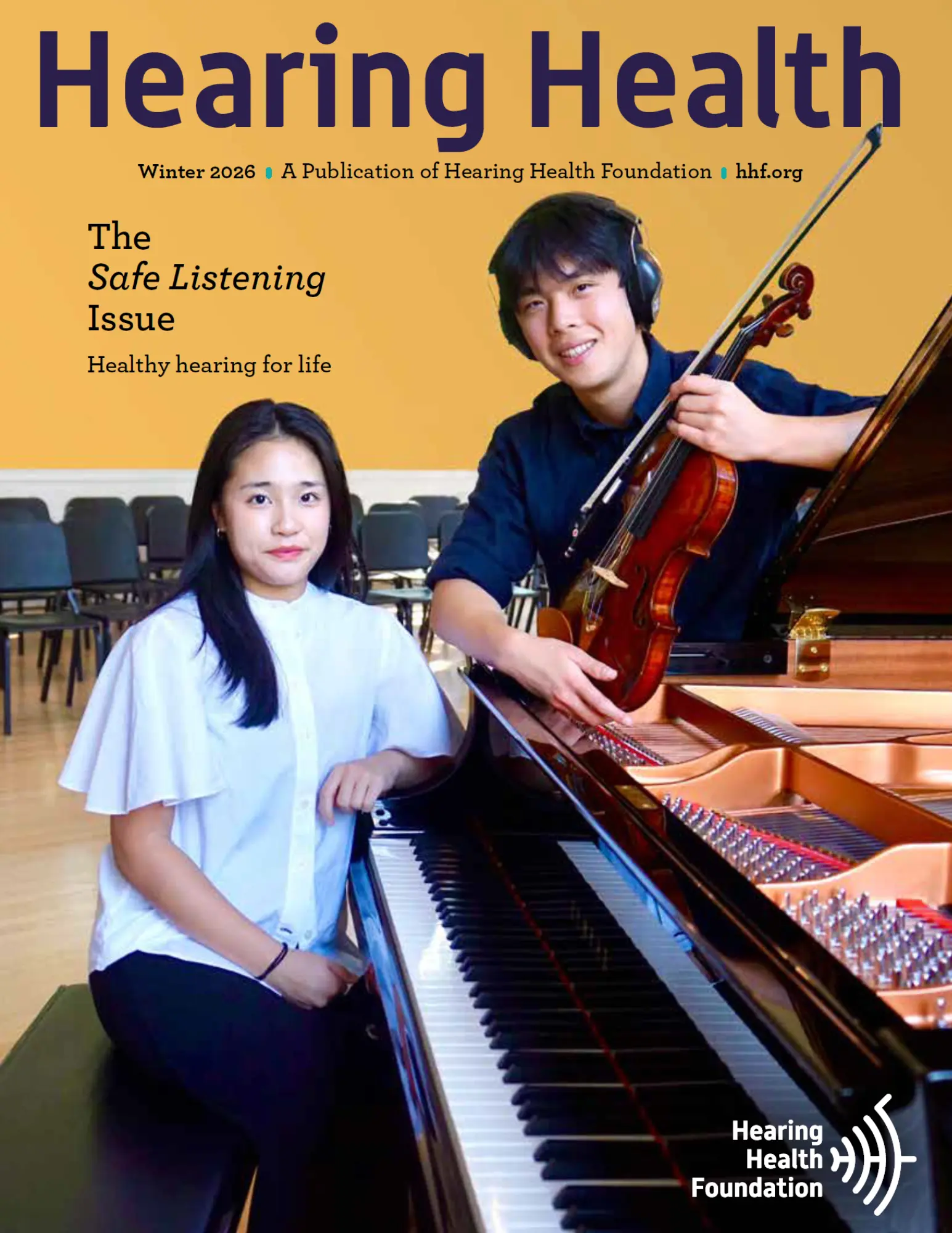
The Winter 2026 edition of Hearing Health provides another direct look at that partnership, identifying current and past Emerging Research Grant investigators whose work has been generously funded by Royal Arch Research Assistance.
Philanthropic Support
Donations help provide research funding for investigators studying CAPD and related areas of auditory science.
Emerging Research Grants
HHF provides a structured grant program supporting innovative investigators throughout hearing and balance science.
Scientific Discovery
Together, charitable support and scientific expertise create opportunities for new knowledge and future advances.
R.A.R.A. Donations at Work
Supporting Emerging Researchers
R.A.R.A. does not operate a hospital, clinic, or treatment center. Its charitable research mission focuses on supporting qualified investigators whose work can expand scientific understanding of auditory processing and related hearing challenges.
Through Hearing Health Foundation's Emerging Research Grants program, contributions from Royal Arch Masons and other R.A.R.A. supporters help provide researchers with opportunities to pursue innovative projects, develop preliminary evidence, and build the foundations for future scientific work.
R.A.R.A. Supported Research Featured in Winter 2026
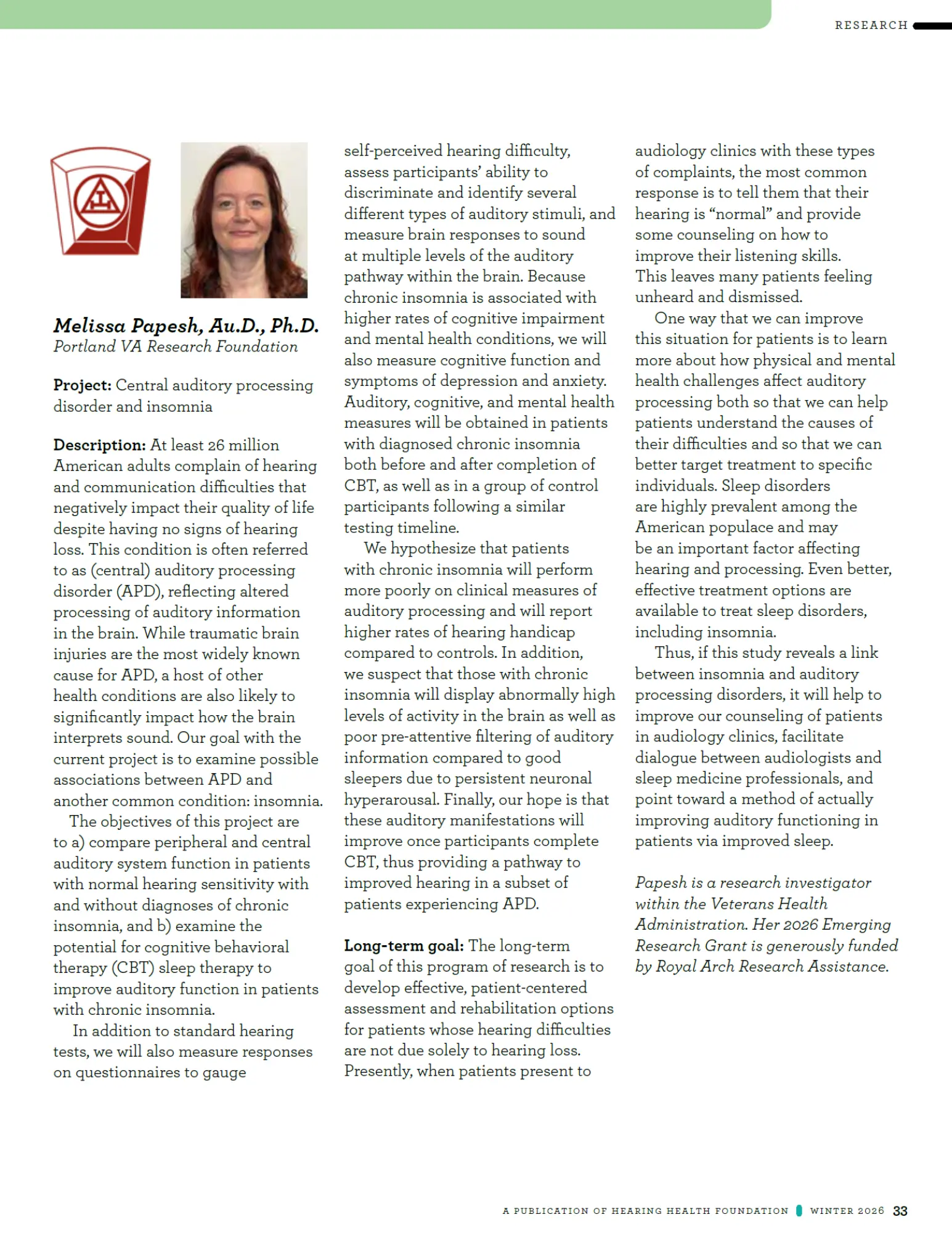
Melissa Papesh, Au.D., Ph.D.
Project: Central auditory processing disorder and insomnia.
Her research examines possible associations between auditory processing disorder and chronic insomnia, including whether treatment of insomnia may improve auditory functioning.
Her 2026 Emerging Research Grant is identified in the Winter 2026 issue as generously funded by Royal Arch Research Assistance.
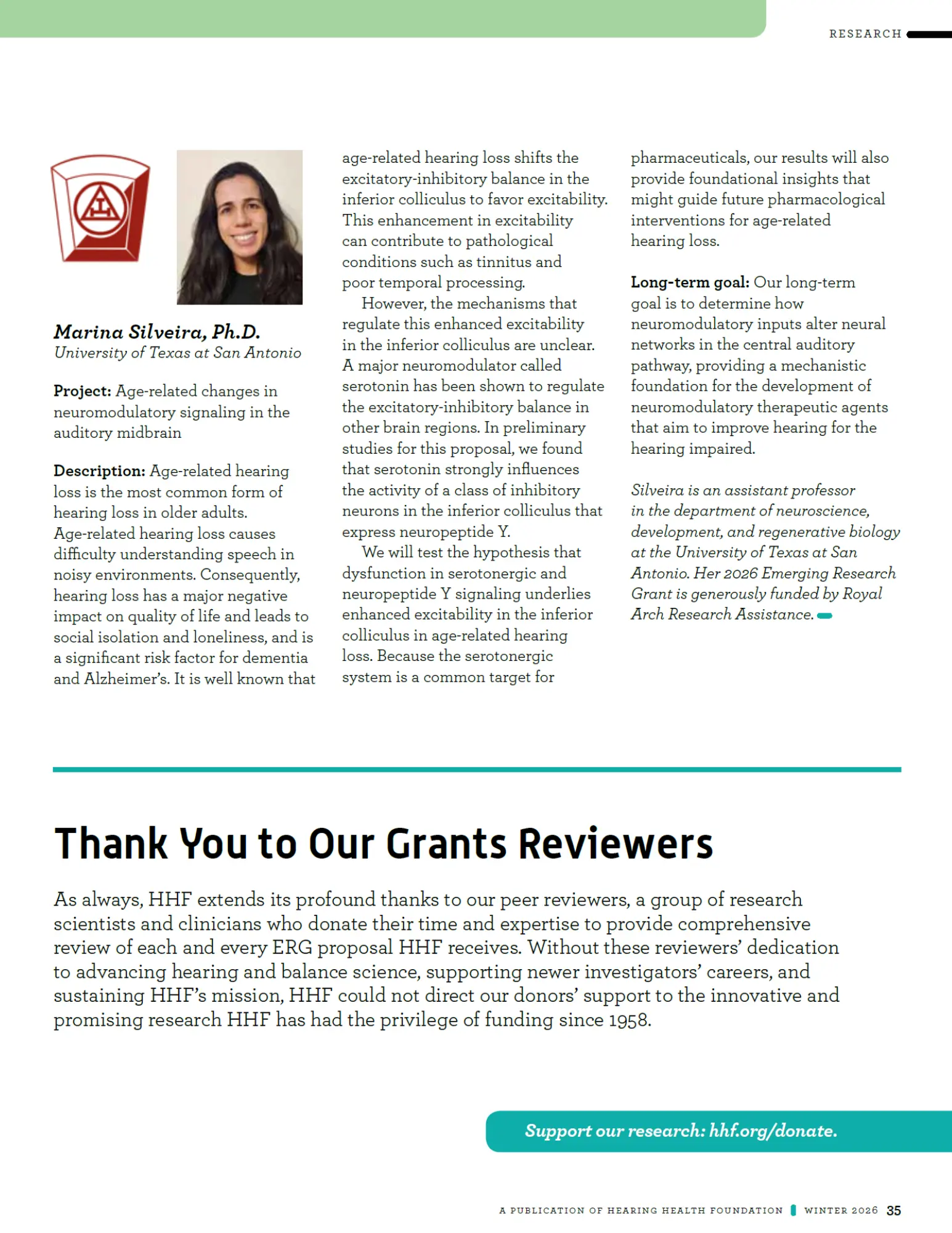
Marina Silveira, Ph.D.
Project: Age-related changes in neuromodulatory signaling in the auditory midbrain.
Her research examines mechanisms associated with age-related hearing loss and how changes in neural signaling may contribute to hearing difficulty.
Her 2026 Emerging Research Grant is also identified as generously funded by Royal Arch Research Assistance.
Carolyn McClaskey, Ph.D.
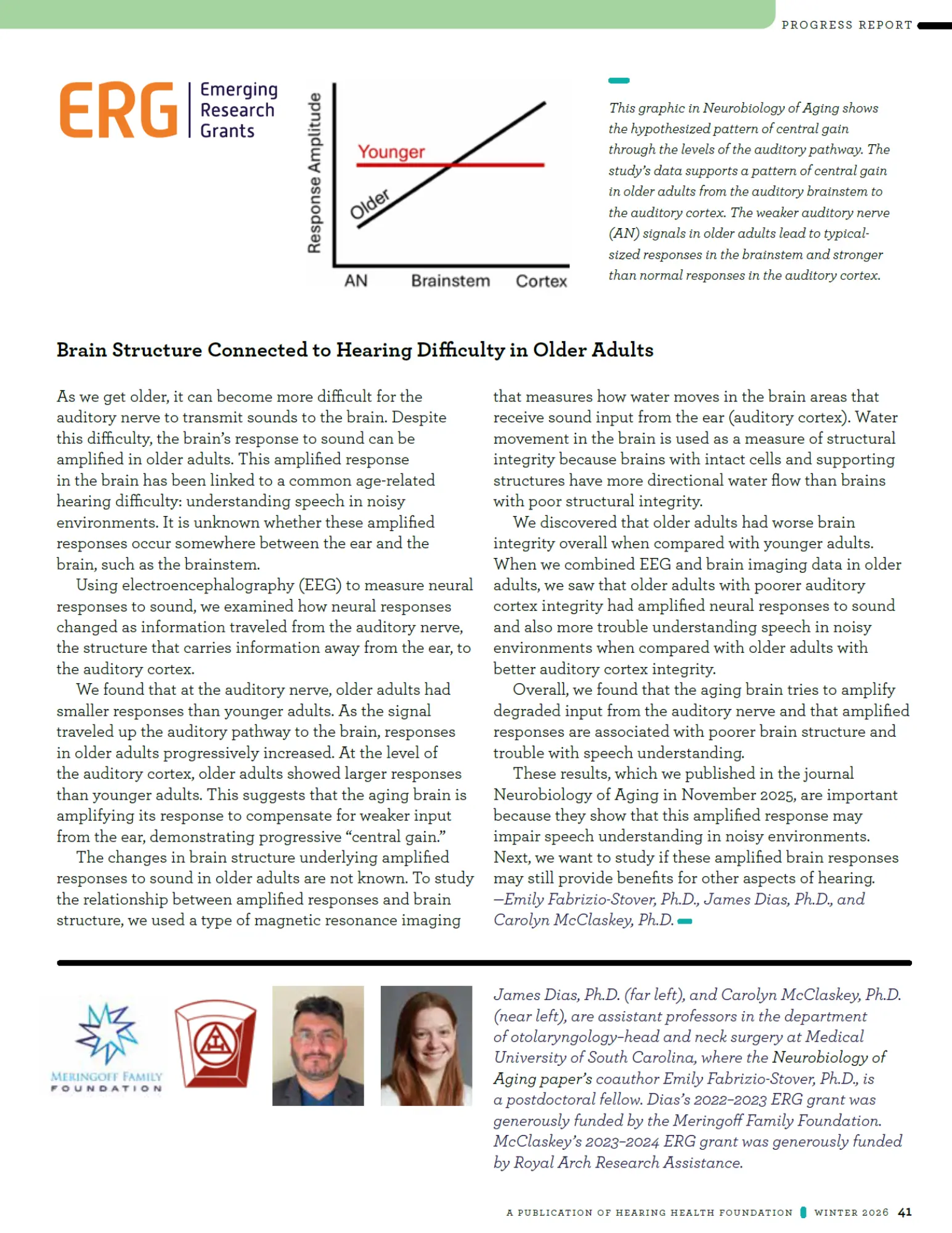
The Winter 2026 issue features a progress report examining changes in neural responses to sound and the relationship between brain structure and difficulty understanding speech in noisy environments among older adults.
The publication identifies Dr. McClaskey's 2023–2024 Emerging Research Grant as generously funded by Royal Arch Research Assistance.
Research Support That Continues Beyond the Grant Year
The Winter 2026 progress report involving Carolyn McClaskey and her colleagues illustrates how an Emerging Research Grant can continue producing scientific results after the original award period.
Their work examined how neural responses change as sound travels from the auditory nerve toward the auditory cortex. The research found evidence that older brains may amplify weakened auditory input, a process associated with poorer brain structure and greater difficulty understanding speech in noisy environments.
The study was published in Neurobiology of Aging in November 2025, demonstrating how earlier charitable research support can contribute to later peer-reviewed scientific findings.
From Philanthropy to Scientific Progress
Exploring New Questions
Research grants allow investigators to examine relationships and mechanisms that may not yet be fully understood.
Building Scientific Evidence
Initial studies can generate meaningful data and contribute to peer-reviewed scientific research.
Supporting Future Discovery
Findings from early research can help establish new directions for expanded studies, assessment, treatment, and future funding.
R.A.R.A. in Hearing Health — Winter 2026
Read the Publication Excerpts
The pages below are selected excerpts from Hearing Health Foundation's Winter 2026 publication featuring research directly connected to support from Royal Arch Research Assistance.
Each page is displayed at a large size for easier reading. Click or tap any page to open the original image at full resolution.
Continuing the Research Partnership
The Winter 2026 issue demonstrates several different ways R.A.R.A.'s partnership with Hearing Health Foundation supports auditory research.
Melissa Papesh and Marina Silveira represent current Emerging Research Grant recipients whose 2026 projects are supported by R.A.R.A., while the progress report involving Carolyn McClaskey demonstrates how a previously funded Emerging Research Grant can continue contributing to scientific knowledge years later.
Together, these projects illustrate the long-term value of supporting investigators at critical stages of scientific development.
Your Support Helps Make Research Possible
Every contribution to Royal Arch Research Assistance strengthens its ability to support scientific investigation. Through the Emerging Research Grants program and its partnership with Hearing Health Foundation, R.A.R.A. continues helping researchers pursue new knowledge, develop meaningful scientific evidence, and advance our understanding of Central Auditory Processing Disorder and the broader field of auditory science.