

Central Auditory Processing Disorder
Central Auditory Processing Disorder, known as CAPD, is a hearing deficiency where individuals can hear sounds but struggle to process and interpret them correctly. Unlike deafness, where the ear does not deliver sound to the brain, CAPD occurs when the brain fails to properly translate the sounds delivered by the ear, resulting in garbled or misunderstood messages.
Key Facts
People with CAPD often have normal hearing and are not considered hearing impaired.
The problem lies in how the brain processes the sounds it receives, which is why it is called a processing disorder.
Normal Hearing
The ears detect sound and deliver it to the brain.
Processing Difficulty
The brain struggles to organize and interpret incoming sound.
Speech Confusion
Words may become garbled, misunderstood, or difficult to follow.
How CAPD Affects Hearing
CAPD affects how the brain understands sound, not how the ears hear it.
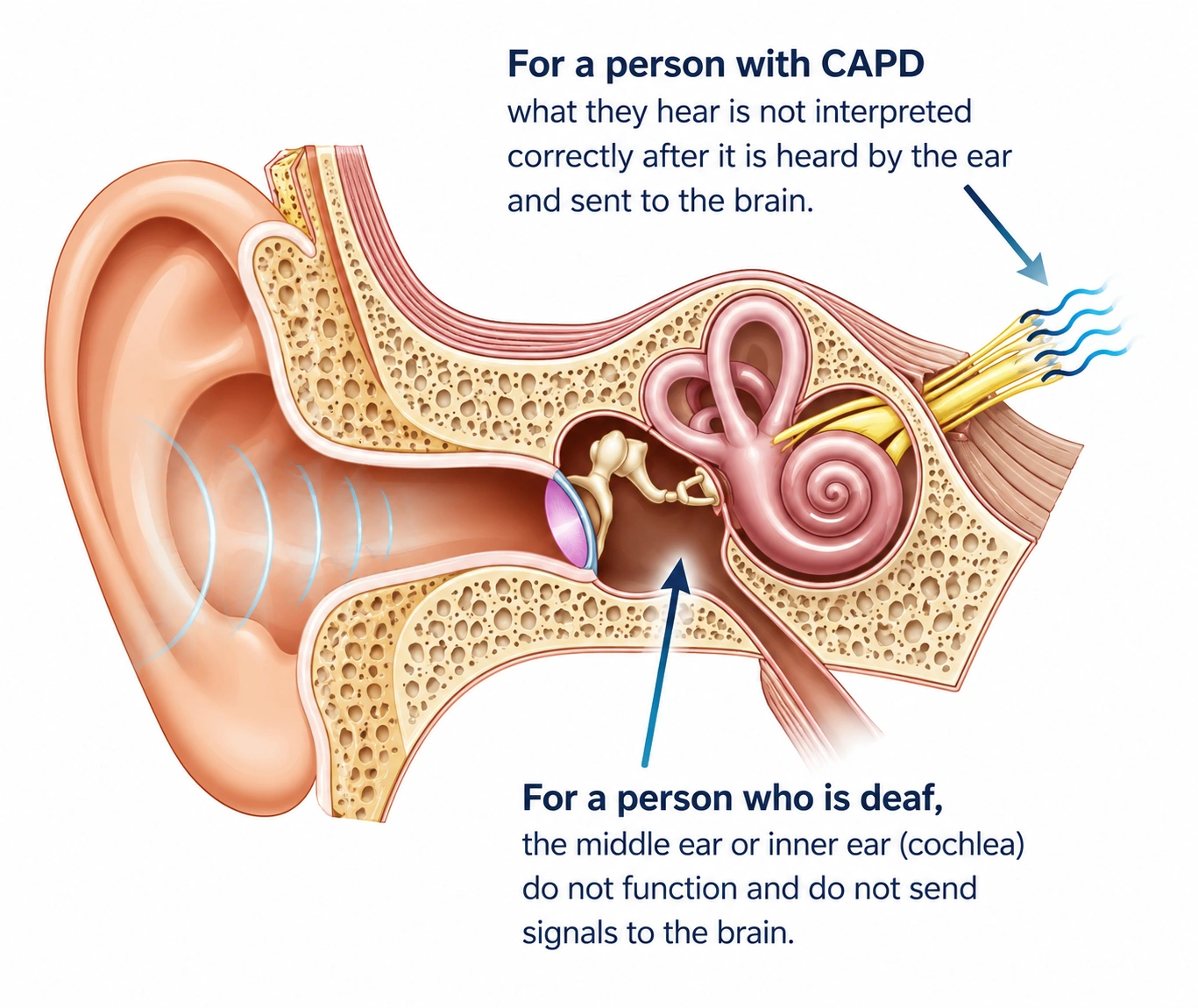
Hearing Versus Processing
Normal Hearing: Sound travels to the inner ear, which delivers it to the brain for accurate translation.
With CAPD: The inner ear functions normally, but the brain misinterprets the sound, leading to confusion and difficulty understanding.
CAPD particularly impacts an individual’s ability to focus in noisy environments, such as classrooms or busy public spaces. Everyday sounds like pencils tapping or birds chirping can overwhelm the central auditory nervous system, making it difficult to concentrate and understand speech.
Why Noisy Environments Are Difficult
Classrooms, restaurants, playgrounds, and busy public spaces create competing sounds. For someone with CAPD, the brain may struggle to separate speech from background noise, making it harder to concentrate, follow instructions, and understand conversations clearly.
Symptoms of CAPD
CAPD symptoms can range from mild to severe and often vary by individual.
Similar Sounds
Difficulty distinguishing between similar sounds, such as coat and boat.
Following Directions
Trouble following directions, especially multi step instructions.
Noise Sensitivity
Sensitivity to loud, sudden, or competing noises.
Academic Challenges
Challenges with reading, spelling, or verbal math problems.
Noisy Environments
Difficulty focusing in classrooms, groups, restaurants, or crowds.
Mishearing Words
Mishearing words or phrases, leading to misunderstandings.
Confusion
Forgetfulness, disorganization, or confusion in noisy settings.
Listening Fatigue
Extra effort to process sound may become tiring or overwhelming.
Questions To Ask Yourself
- Is your child unusually bothered by noise?
- Does their behavior improve in quieter environments?
- Are conversations or following instructions challenging?
- Does your child often ask people to repeat themselves?
- Do teachers report listening or attention concerns?
- Does your child seem overwhelmed in busy places?
Behaviors Reported By CAPD Patients
A sampling of clients diagnosed with CAPD by the Able Kids Foundation highlights common behaviors.
Sensitivity to sounds and being easily distracted.
Mispronouncing words or confusing similar sounding ones.
Experiencing frustration, anxiety, or forgetfulness.
Difficulty following directions in noisy places.
Weak grasp of phonics and listening based learning.
Trouble with verbal communication.
Diagnosing CAPD
If you suspect CAPD in your child, consult an audiologist. Audiologists are the professionals qualified to diagnose CAPD.
- Auditory Figure Ground: Difficulty focusing on sounds when background noise is present.
- Auditory Memory: Trouble remembering information like directions or study materials.
- Auditory Discrimination: Difficulty distinguishing between similar words or sounds.
- Auditory Attention: Inability to focus on auditory tasks for extended periods.
- Auditory Cohesion: Challenges with complex listening tasks, riddles, or verbal math.
Since most diagnostic tests require specific language and cognitive skills, children are often not diagnosed until they are approximately seven years old or older.
Managing CAPD
Early diagnosis and intervention can significantly improve outcomes for individuals with CAPD.
Speech and Language Therapy
Enhances auditory processing skills and comprehension.
Audiologist Evaluations
Provides tailored recommendations for managing CAPD.
Supportive Environments
Structured and quiet settings reduce distractions.
Assistive Technology
Tools like hearing devices may improve auditory focus.
Without proper intervention, CAPD can result in academic and social challenges. However, with the right support, individuals can thrive.
How R.A.R.A. Supports CAPD Research
Your contributions to Royal Arch Research Assistance directly support research aimed at understanding, treating, and eventually curing CAPD. By funding groundbreaking studies, R.A.R.A. is helping to create a brighter future for those living with this disorder.
Donate Now