

R.A.R.A. and Hearing Health Foundation
Royal Arch Research Assistance (R.A.R.A.) continues its longstanding partnership with the Hearing Health Foundation through support of the Emerging Research Grants program.
The Spring 2026 edition of Hearing Health features scientific work connected to both current and previous R.A.R.A.-supported Emerging Research Grant investigators.
The projects featured in this issue demonstrate an important aspect of research philanthropy: an initial grant can help investigators build scientific programs whose work continues generating new discoveries, publications, and research tools years later.
Provides Research Support
Donations help support Emerging Research Grants in auditory processing and related areas of hearing science.
Supports Investigators
HHF's Emerging Research Grants program provides scientists with opportunities to pursue innovative research.
Research Continues
Supported investigators can continue building upon their work long after the original grant period.
R.A.R.A. Donations at Work
Supporting Scientific Investigation
R.A.R.A.'s charitable mission is centered on research. Rather than operating hospitals or treatment facilities, the organization helps provide qualified investigators with resources to pursue scientific questions involving auditory processing and related hearing conditions.
Through Hearing Health Foundation's Emerging Research Grants program, charitable contributions can help investigators establish research programs, publish findings, develop new scientific tools, and pursue questions that may ultimately contribute to better understanding and treatment of auditory disorders.
R.A.R.A. Supported Researchers Featured in Spring 2026
Marina Silveira, Ph.D.
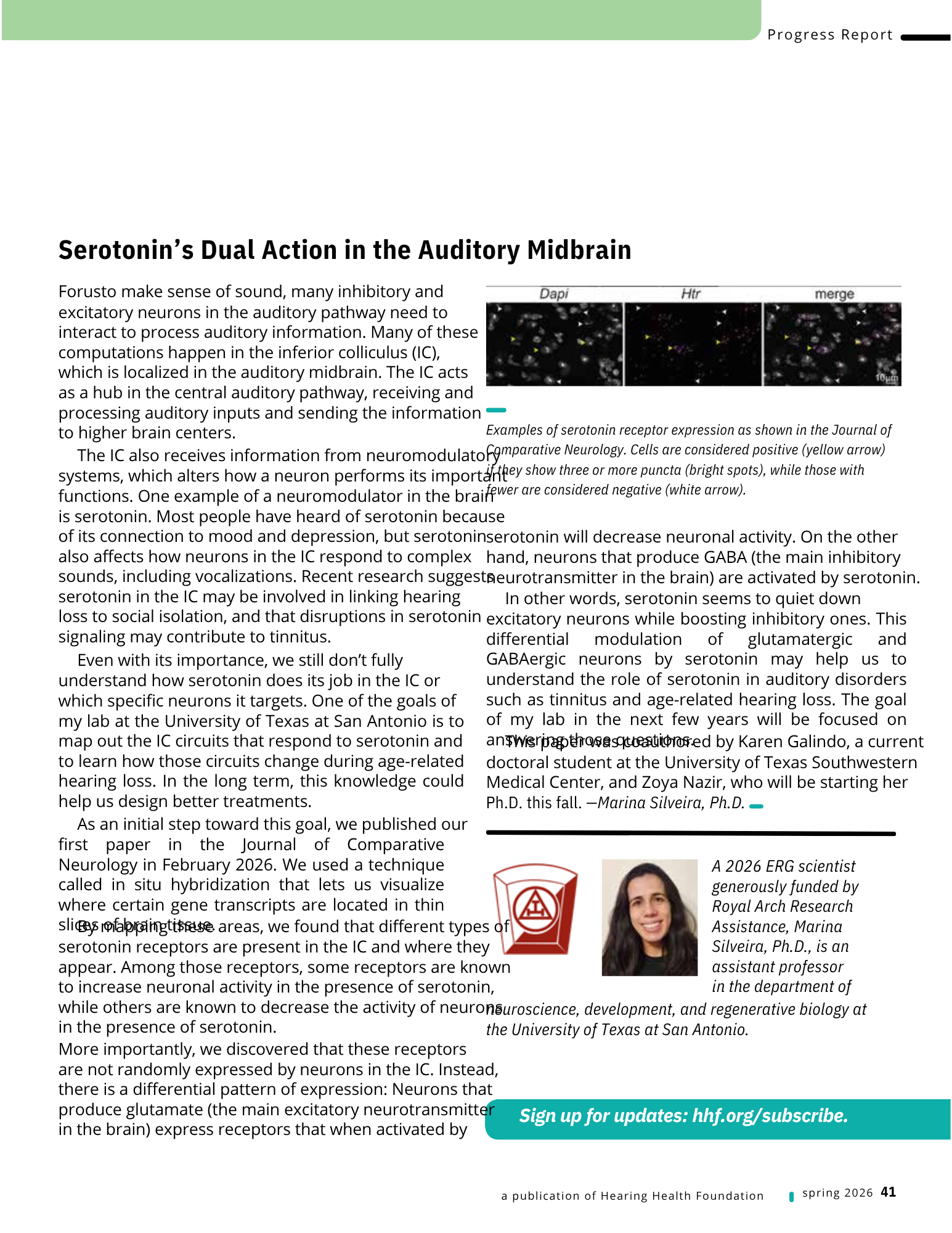
Dr. Silveira is identified in the Spring 2026 issue as a 2026 Emerging Research Grants scientist generously funded by Royal Arch Research Assistance.
Her laboratory studies serotonin signaling within the inferior colliculus, an important hub of the auditory midbrain where inhibitory and excitatory neurons interact to process sound.
Her work seeks to better understand how serotonin influences auditory processing and how those mechanisms may change during age-related hearing loss.
Manoj Kumar, Ph.D.
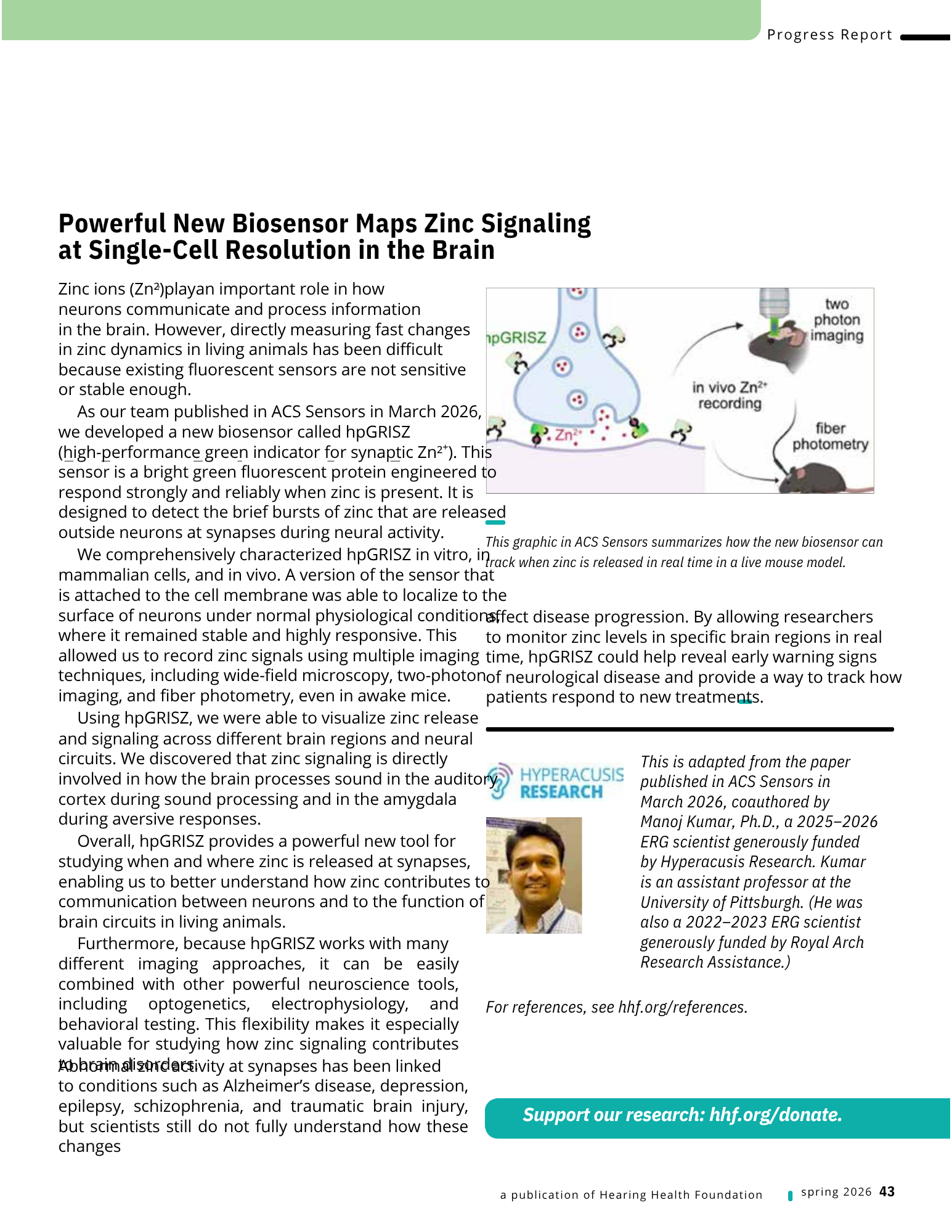
The Spring 2026 issue features Dr. Kumar's work involving a new fluorescent biosensor designed to measure zinc signaling in the brain.
While his 2025–2026 Emerging Research Grant is funded by Hyperacusis Research, the publication specifically notes that Dr. Kumar was also a 2022–2023 Emerging Research Grants scientist generously funded by Royal Arch Research Assistance.
His continuing work illustrates how an earlier R.A.R.A.-supported researcher can go on to develop new scientific tools and discoveries.
Serotonin and the Auditory Midbrain
Dr. Marina Silveira's research focuses on the role serotonin plays in the inferior colliculus, a central processing hub within the auditory pathway.
Her laboratory found that serotonin receptors appear in different patterns among neurons in the auditory midbrain. The findings suggest that serotonin may quiet certain excitatory neurons while increasing activity among inhibitory neurons.
This differential effect may help researchers better understand serotonin's role in auditory disorders including tinnitus and age-related hearing loss.
The laboratory's first paper resulting from this work was published in the Journal of Comparative Neurology in February 2026.
A New Tool for Mapping Zinc Signaling
Dr. Manoj Kumar and his research team developed a new biosensor called hpGRISZ, designed to detect rapid changes in zinc signaling within living neural systems.
Using the biosensor, researchers were able to visualize zinc release and signaling across different brain regions and neural circuits. Their findings showed that zinc signaling is involved in sound processing within the auditory cortex as well as activity within the amygdala.
Because abnormal zinc signaling has also been associated with neurological conditions including Alzheimer's disease, depression, epilepsy, schizophrenia, and traumatic brain injury, the technology may have applications extending well beyond auditory research.
The work was published in ACS Sensors in March 2026.
From Early Support to Continuing Discovery
Current Research
Marina Silveira represents a current 2026 investigator whose Emerging Research Grant is directly supported by R.A.R.A.
Continuing Research
Manoj Kumar demonstrates how a researcher previously supported by R.A.R.A. can continue producing new scientific discoveries.
Building Knowledge
Both projects contribute new tools and understanding that can help advance the broader field of auditory neuroscience.
R.A.R.A. in Hearing Health — Spring 2026
Read the Publication Excerpts
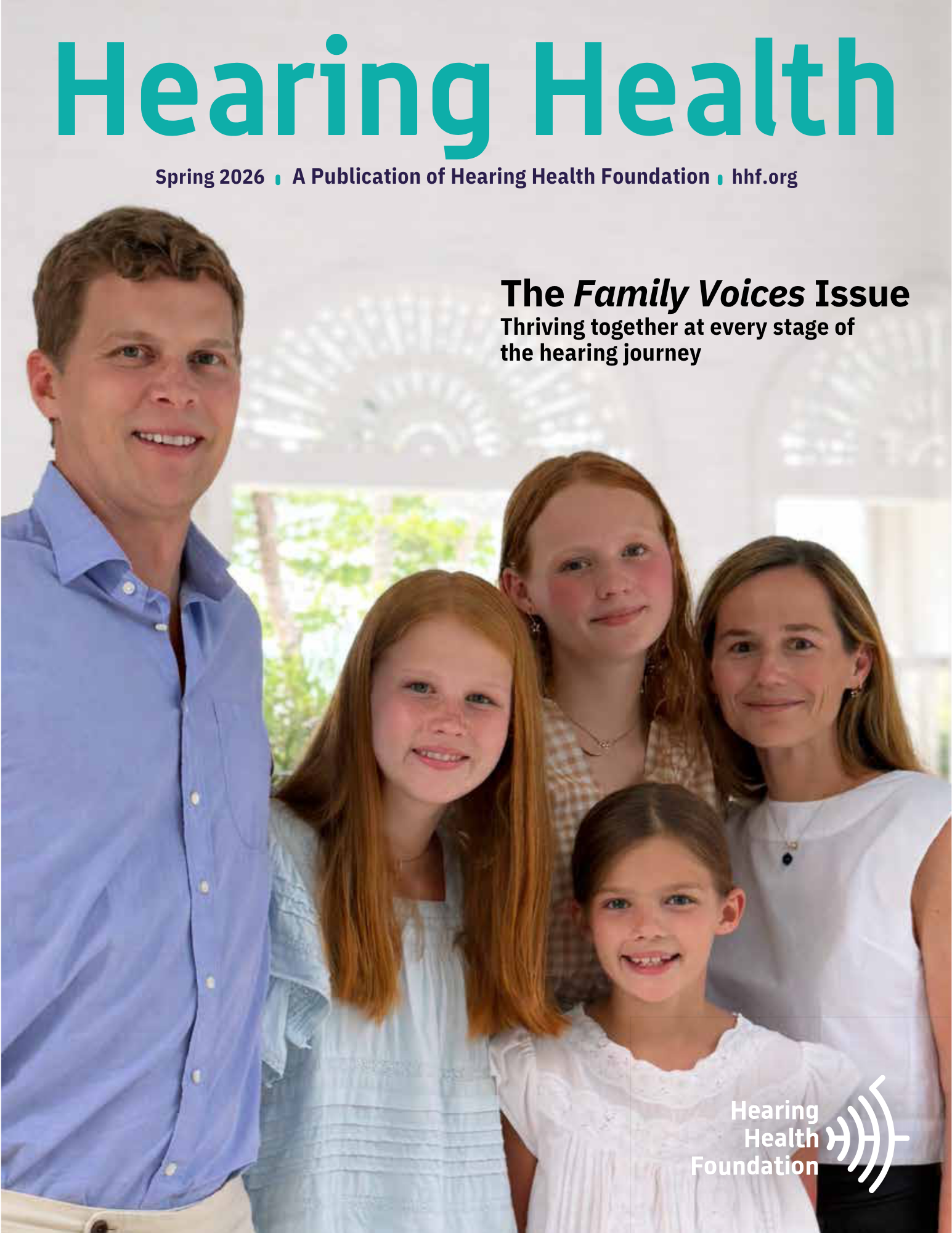
The following pages are selected from Hearing Health Foundation's Spring 2026 publication and show the research connections between Royal Arch Research Assistance and the investigators featured above.
Each page is displayed at a large size for easier reading. Click or tap any page to open the original image at full resolution.
A Partnership with Continuing Impact
The Spring 2026 issue offers two complementary examples of how R.A.R.A.'s support of Hearing Health Foundation's Emerging Research Grants can create lasting scientific value.
Marina Silveira represents a current R.A.R.A.-funded investigator advancing understanding of serotonin and auditory processing, while Manoj Kumar's later work demonstrates how a researcher supported by R.A.R.A. during an earlier grant period can continue developing important scientific innovations.
Together, these projects help illustrate why supporting emerging scientists remains an important component of R.A.R.A.'s mission.
Your Support Helps Research Move Forward
Every contribution to Royal Arch Research Assistance strengthens its ability to support scientific investigation. Through the Emerging Research Grants program and its partnership with Hearing Health Foundation, R.A.R.A. helps create opportunities for researchers to pursue new questions, develop innovative technologies, and expand our understanding of auditory processing and hearing health.